Microsoft 365 E7: The New AI-Powered Enterprise License #
Microsoft has introduced Microsoft 365 E7, a new enterprise licensing suite designed around AI, Copilot, and autonomous agents. The announcement signals a significant shift in how Microsoft is packaging capabilities for the next generation of enterprise productivity and automation.
For organizations already operating within E3 and E5 environments, this announcement raises an important question:
Is E7 simply another licensing tier, or is it the beginning of a fundamentally new AI-driven enterprise platform?
Based on Microsoft’s announcements and early partner guidance, E7 appears to represent a new licensing model designed to support AI-first enterprise operations.
Why Microsoft Created the E7 License #
Over the last two years Microsoft has rapidly expanded its AI ecosystem:
- Microsoft 365 Copilot
- Copilot Studio
- Security Copilot
- AI agents across Microsoft services
- automation across Power Platform
- large-scale enterprise data integration
Previously, these capabilities were distributed across multiple add-ons and licensing layers.
The introduction of E7 bundles many of these AI-driven capabilities into a single enterprise license, allowing organizations to adopt AI-driven workflows at scale.
In many enterprise environments, administrators have struggled with Copilot licensing complexity and fragmented AI services. E7 appears designed to simplify that architecture.
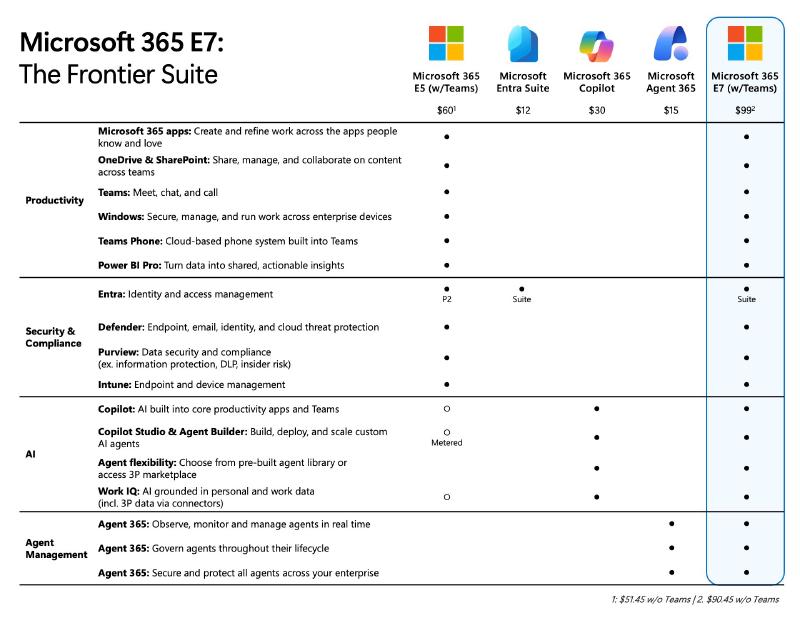
What Microsoft 365 E7 Includes #
While Microsoft has not yet published a final SKU comparison chart, early documentation indicates that E7 builds on the E5 platform and introduces capabilities centered around:
AI and Copilot Integration #
E7 focuses heavily on enterprise AI capabilities including:
- Microsoft 365 Copilot
- Copilot-powered automation
- AI agents capable of performing multi-step tasks
- deeper integration with enterprise data
The emphasis is less about productivity tools themselves and more about AI acting as an operational layer across the Microsoft ecosystem.
Enterprise Agent Framework #
One of the more interesting aspects of the E7 announcement is the focus on agents.
Agents represent task-oriented AI systems capable of:
- executing workflows
- retrieving enterprise data
- coordinating tasks across applications
- interacting with employees through natural language
In practical terms, this could allow organizations to build AI-driven automation that operates across:
- Microsoft 365
- Power Platform
- Dynamics
- custom enterprise systems
For many organizations this represents the next evolution beyond traditional Power Automate workflows.
Enterprise Data Protection and Trust #
Microsoft has also positioned E7 around trusted AI adoption.
AI systems require large amounts of enterprise data to function effectively, which introduces new concerns around:
- data protection
- governance
- identity
- access control
Because of this, E7 continues Microsoft’s pattern of bundling advanced security and compliance features alongside new productivity capabilities.
For organizations already running Microsoft 365 E5, the security stack will feel familiar, but with deeper integration into AI-driven workloads.
What This Means for Enterprise Administrators #
For Microsoft 365 architects and administrators, E7 introduces several important considerations.
1. AI Will Become a Core Platform Layer #
Historically Microsoft 365 was centered around:
- collaboration
- document management
- identity and security
E7 represents a shift where AI becomes a primary platform capability.
Administrators should expect increasing architectural decisions around:
- AI data access
- information governance
- Copilot permissions
- enterprise search boundaries
- AI workflow automation
2. Identity and Security Become Even More Critical #
AI systems amplify the impact of identity and access configuration.
In large enterprise tenants, improperly scoped access could allow AI agents to retrieve or summarize sensitive data across the environment.
This reinforces the importance of:
- Entra ID governance
- Conditional Access
- Privileged Identity Management
- sensitivity labels
- data loss prevention
Organizations planning to adopt E7 will likely need mature identity governance and data classification models.
3. Licensing Strategy Will Change #
Many organizations have historically standardized around E3 + add-ons or E5 licensing.
E7 introduces another potential model:
- Core workforce → E3
- Security / advanced compliance → E5
- AI-driven productivity → E7
It remains to be seen how Microsoft positions pricing and eligibility, but the clear direction is toward AI-enabled enterprise operations.
Early Takeaways #
Although Microsoft 365 E7 is still in its early announcement phase, several trends are clear:
- AI is becoming a core enterprise platform capability
- Copilot is evolving beyond productivity into workflow automation
- Microsoft is investing heavily in enterprise AI governance
- licensing will increasingly revolve around AI capabilities rather than individual applications
For Microsoft 365 administrators and architects, the next few years will likely involve rethinking tenant architecture around AI access and data governance.
Final Thoughts #
Microsoft 365 E7 is more than just another licensing tier. It represents Microsoft’s vision for an AI-first enterprise platform where Copilot and agents become part of daily operations.
For organizations already invested in Microsoft 365, this evolution raises important architectural questions around:
- AI governance
- enterprise data security
- automation strategy
- identity architecture
Administrators who begin planning for these changes now will be far better positioned as AI becomes deeply integrated into enterprise productivity.
Sources #
- Microsoft announcement: https://www.microsoft.com/en-us/microsoft-365/blog/2026/03/09/powering-frontier-transformation-with-copilot-and-agents/
- Microsoft Partner Blog: https://techcommunity.microsoft.com/blog/partnernews/partner-blog--introducing-microsoft-365-e7-the-frontier-suite/4500520
- Microsoft Blog: https://blogs.microsoft.com/blog/2026/03/09/introducing-the-first-suite-built-on-intelligence-trust
Related Reading #
• Teams Live Meeting Indicator: What It Means for Collaboration